SRE troubleshooting
Watches your observability events, troubleshoots what fires and takes the proactive step you approved, before anyone is paged.


Agents run on your nodes with only the access you give them. Each works in its own sandbox and every action is logged.
Agent
1 / 5
Clear instructions and approved know-how, written by your team. It follows them instead of making things up.
OpenClaw, Hermes Agent, NanoClaw and OpenShell run on the platform today, deployed from the catalogue to your own nodes.
 OpenClaw
 Hermes Agent
 NanoClaw
 OpenShell
Any agentic framework is compatible, from Google ADK to Microsoft Agent Framework to LangChain. Nothing in an agent depends on a runtime library that only works in one cloud.
The problem is rarely how clever the agent is. It is whether anyone can trust it with access. That is the part we build first. And not every task needs an agent: many need a simple automation or a single AI step. If yours does, we will say so.
Use cases
Our predefined agents already run IT operations on the platform: they watch, investigate and report, and change only what you have approved. The runtime runs any agent, so the same platform carries the rest of your work.
Watches your observability events, troubleshoots what fires and takes the proactive step you approved, before anyone is paged.
Investigates an incident over a fixed window and reports what happened, with evidence behind every claim.
Reads the logs your agents leave behind and flags what failed and what looks wrong.
Turns the data you already collect into the report someone used to compile by hand, on a schedule.
Agents that plan, write, review and test code, each run in its own sandbox with only the repositories it needs.
Agents that work through tickets, documents and approvals in the systems your teams already use.
Multi-step workflows that hand work between agents and people, with every model and tool call recorded.
An agent you built and maintain, on any framework, runs here the same way as ours.
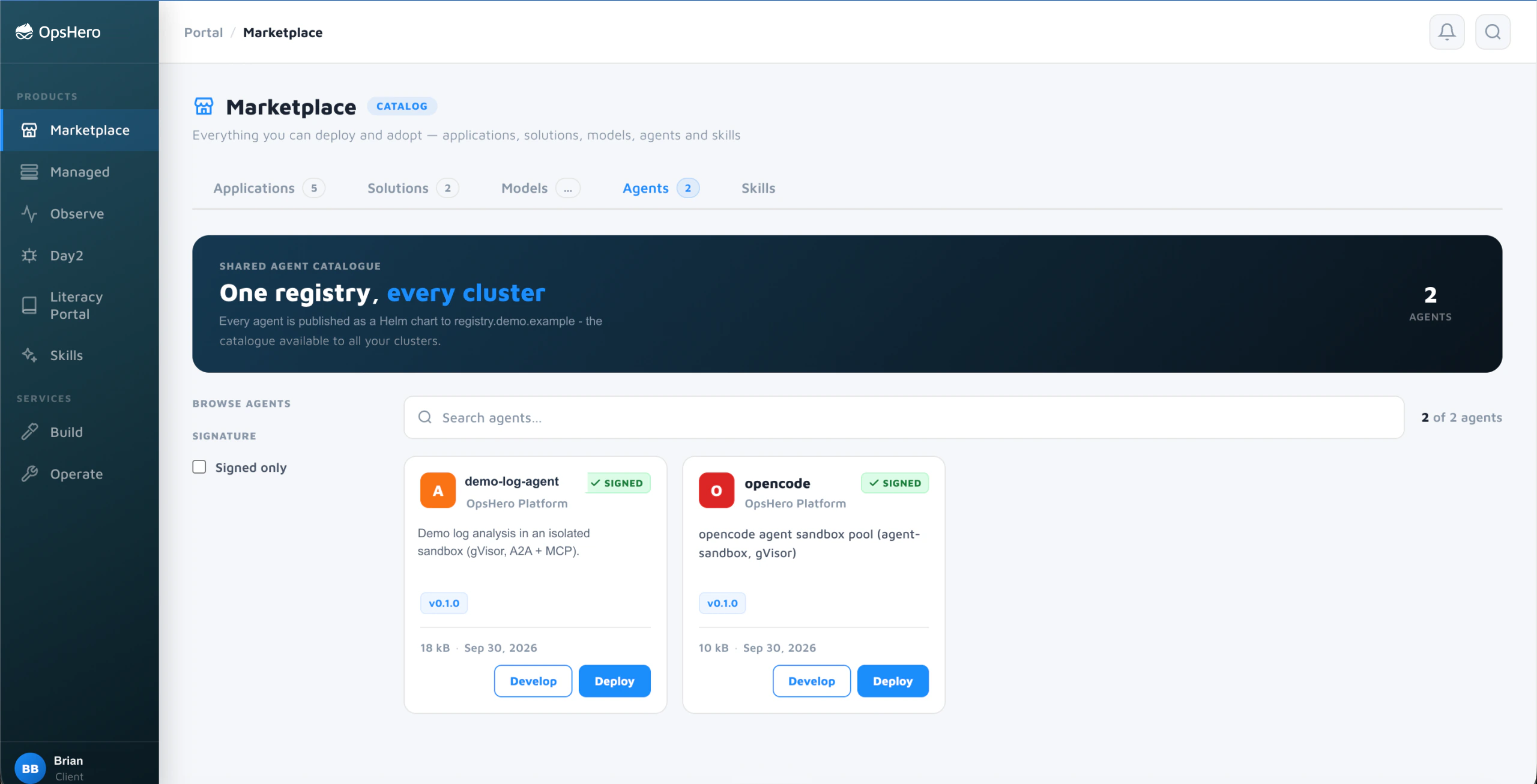
Public skill registries are already a target. Snyk scanned 3,984 public agent skills in February 2026: 36.8% had at least one security issue, 13.4% a critical one, and 76 malicious payloads were confirmed by human review. Koi Security audited all 2,857 skills on ClawHub the same month and found 341 malicious ones, 335 of them from a single campaign delivering a macOS credential stealer.
Yes. Agents run as workloads on your nodes. Model calls can stay local if you run models locally.
Its permissions, its sandbox and its network policy, in that order. Not its instructions, because those can be overridden by what it reads.
Any model behind the gateway: local open-weight models or the hosted APIs you already pay for.
Either. Most first agents are built with us, in an engagement.
Not on its own. A chatbot answers; an agent acts on what the model concludes. When a coding assistant runs unattended, on a schedule, with its own identity, it becomes one, and then everything above applies. We also run no-code and low-code agents built on top of Claude Code, and they are treated exactly like an agent built in code.
You pay for the cluster control plane, and there is no limit on how many agents you run. If you would rather not build them yourself, we can also build and maintain the agents for you.
One portal, one cluster list, one set of identities.
Managed Kubernetes on any machine you choose. No public IP needed.
Open ClustersSigned applications from one catalogue, deployed to any cluster.
Open ApplicationsDevelopment, staging and production, set up the same way.
Open EnvironmentsA separate microVM for every agent task.
Open SandboxesOpen-weight models on your GPUs, behind one OpenAI-compatible gateway.
Open ModelsOne OpenAI-compatible endpoint for every model, local or hosted.
Open AI GatewayOne approved catalogue of what your agents may use.
Open Skills ManagerThe Kubernetes API, scheduler and etcd, run for you.
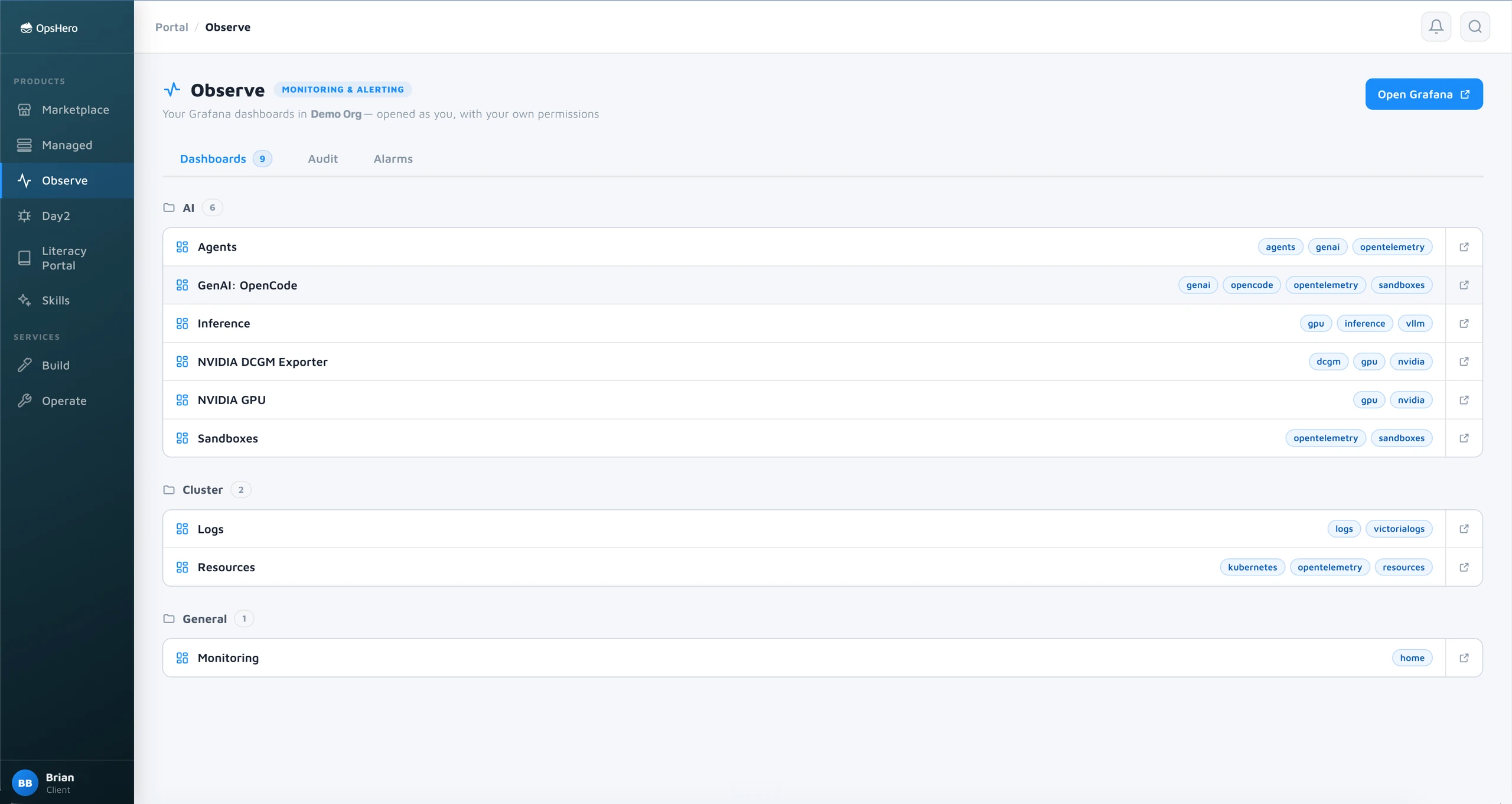
Open Control PlaneDashboards and alerts that arrive with the cluster.
Open ObservabilityAn SRE agent that starts investigating before anyone is paged.
Open Day2