Clusters
Managed Kubernetes on any machine you choose. No public IP needed.
Open Clusters

Open-weight models and your own models run on GPUs you choose. Every model call, local or hosted, goes through one gateway.
We serve, route and observe models. We do not fine-tune them.
Three states, and most companies are in all three.
Staff paste company data into whatever assistant they like. Nobody can say which model saw what.
Your product calls a hosted model API. The bill arrives monthly, and it is the first time anyone sees the number.
A team wants to try an open-weight model. Getting drivers, serving, routing and monitoring to work together takes weeks before the first answer comes back.
Your apps, agents and staff tools.
One OpenAI-compatible endpoint, with all your MCP servers and A2A Agent Cards in one place. Point your tools at it once.
Rules that run before a request reaches a model and before an answer reaches a person.
Local serving: open-weight models on your GPUs, and nothing leaves the cluster. Or hosted providers: still available, now with a budget and a record.
Observability runs under all of it: tokens, latency, cost and GPU use, per team and per model.
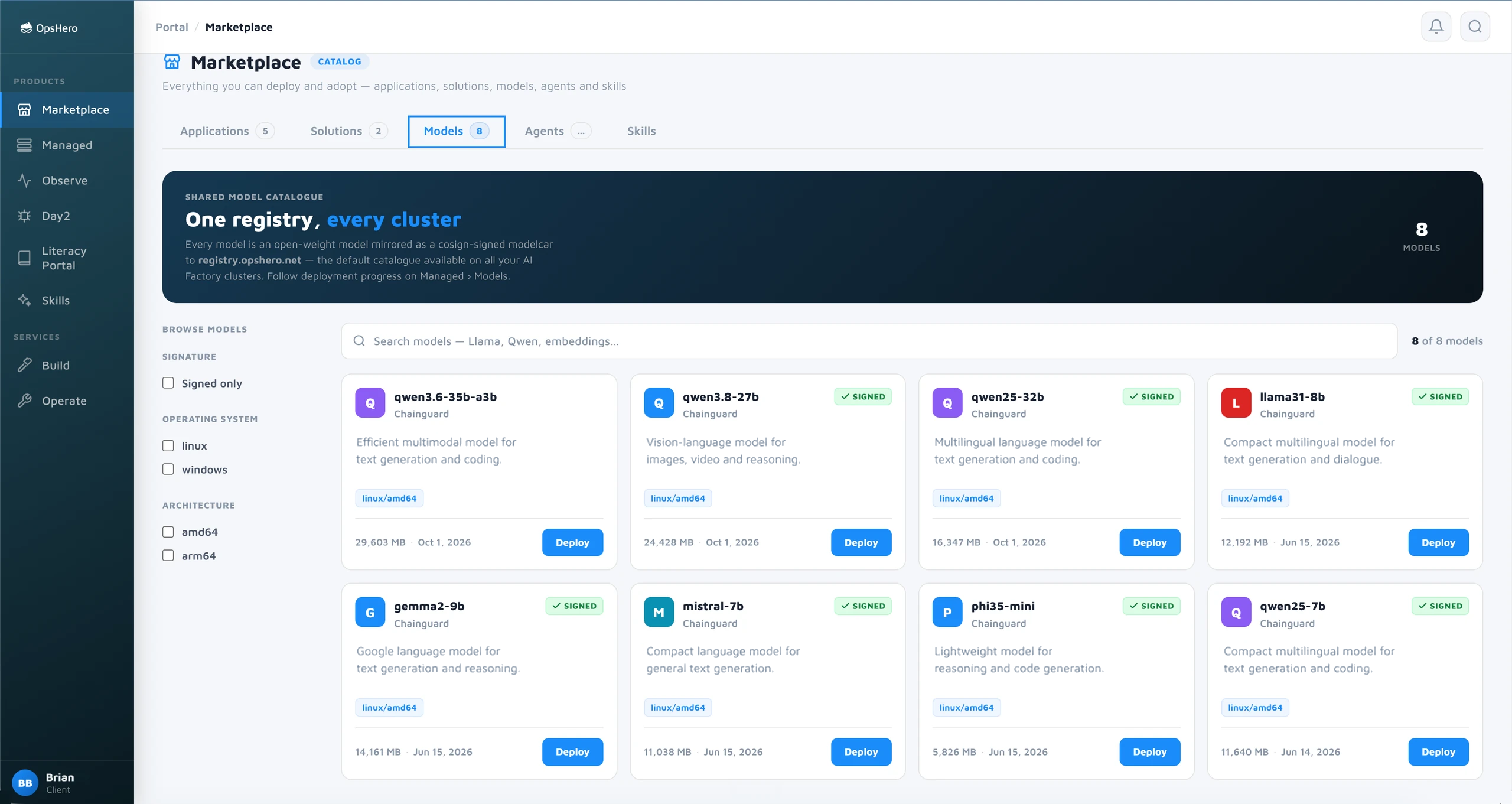
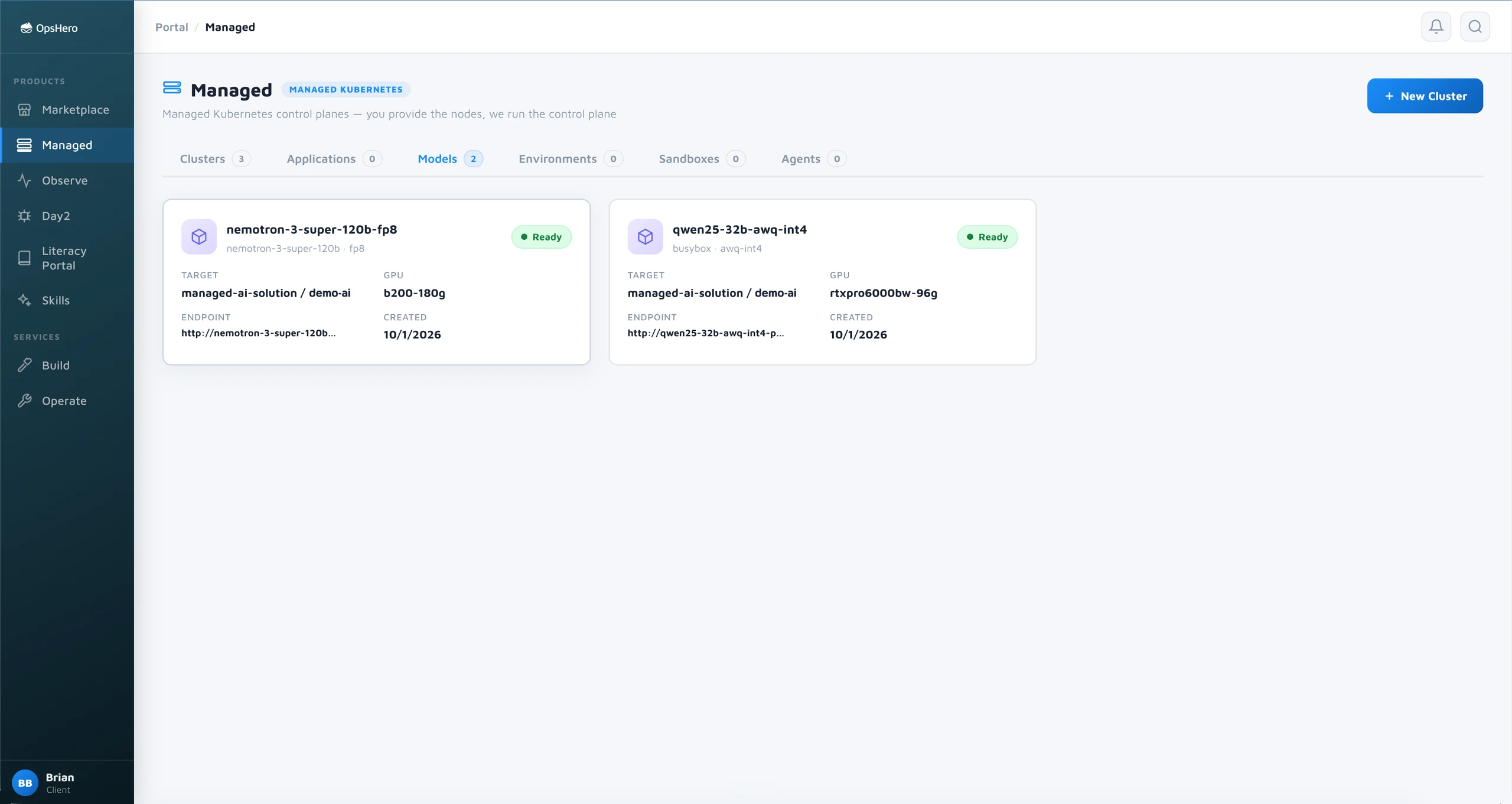
Open-weight models are mirrored into one registry as signed images, so a cluster never pulls from a public hub at deploy time. Choose the model and the GPU; drivers, model distribution and serving are set up as one solution. Upload your own models to the same registry – they are visible only to you. GPU and CPU nodes can be split, so expensive GPUs serve models and nothing else.
 Qwen
 Llama
 Gemma
 Mistral
 Phi
 Kimi
 DeepSeek
Local models and hosted APIs behind one endpoint, with your MCP servers and A2A Agent Cards in the same place. Set budgets per team, see who spent what, fail over when a provider is slow. Moving a tool from one model to another is a routing change, not a reconfiguration of every laptop.
Stays yours
What we see
Gateway metadata needed to enforce budgets and show usage.
Agents run in isolated sandboxes on your own nodes, with only the access you give them: no cluster visibility, network rules per sandbox, short-lived environments drawn from a warm pool. Agents find each other and their tools through the same gateway.
Fast, rule-based checks catch things like card numbers or personal ID numbers on the way in or the way out. Model-based checks judge a request against your own policy. Both run at the gateway, so they apply to every tool at once.
No. Most customers route both: heavy tasks to a hosted model, routine ones to a local model, with no change to the tools.
No. We serve, route, restrict and observe models; we do not train them.
Yes. The gateway is one OpenAI-compatible endpoint, for local and hosted models alike.
You pay for the control plane and the Sovereign AI enablement. There are no limits on GPUs or models.
One portal, one cluster list, one set of identities.
Managed Kubernetes on any machine you choose. No public IP needed.
Open ClustersSigned applications from one catalogue, deployed to any cluster.
Open ApplicationsDevelopment, staging and production, set up the same way.
Open EnvironmentsA separate microVM for every agent task.
Open SandboxesAutonomous agents with only the access you give them.
Open AgentsOne OpenAI-compatible endpoint for every model, local or hosted.
Open AI GatewayOne approved catalogue of what your agents may use.
Open Skills ManagerThe Kubernetes API, scheduler and etcd, run for you.
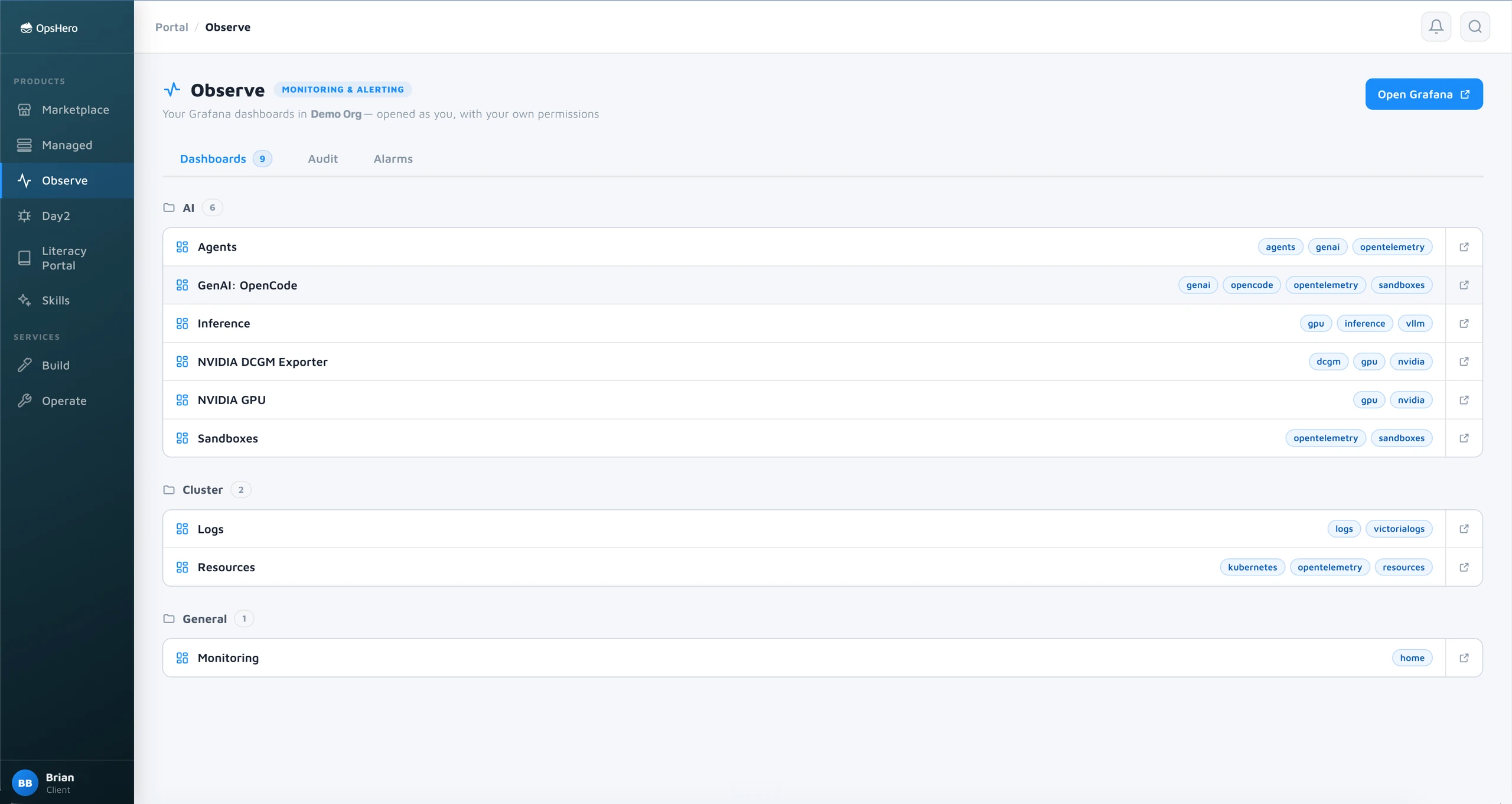
Open Control PlaneDashboards and alerts that arrive with the cluster.
Open ObservabilityAn SRE agent that starts investigating before anyone is paged.
Open Day2